
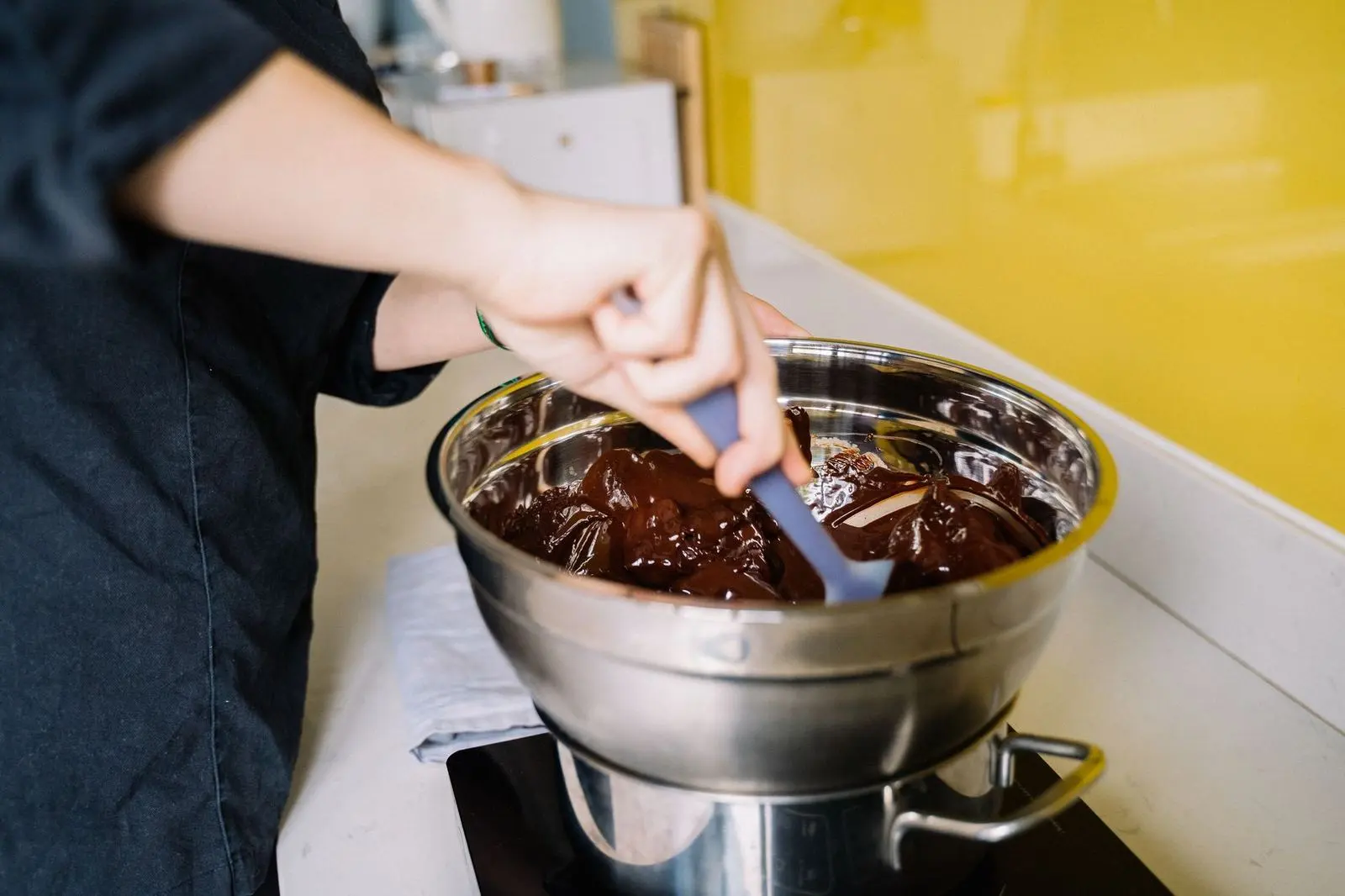
Worried your chocolate will burn or turn grainy? Here is how to melt chocolate: chop it, heat it gently in short microwave bursts or over a double boiler, stir often, and keep every drop of water out.
This guide is part of our baking ingredients and kitchen guide, which collects ingredient and technique basics for home bakers.
| Item | Value |
|---|---|
| Microwave bursts for a typical batch | 30-second intervals, stirring after each |
| Microwave bursts for one ounce or less | 15-second intervals |
| Microwave power for dark chocolate | Medium or high |
| Microwave power for milk or white chocolate | Low |
| Water depth in a double boiler pot | An inch of water |
| Seizing rescue with water | A tablespoon of hot water at a time |
These figures come from Beyond Wonderful and Live Eat Learn. Recommendations can change and vary by recipe, so check the sources before you rely on them.
Why melted chocolate goes wrong
A King Arthur Baking tester describes two enemies: heat and moisture. According to that write-up, chocolate that gets too hot will burn, chocolate that does not get hot enough will be lumpy, and chocolate that gets wet will turn gritty and sludgy.
The same write-up says the key is to get chocolate completely and evenly melted without scorching from too much heat exposure. It compared five different methods, and each test used 3 oz. of chopped bittersweet chocolate. Larger quantities take longer to melt than the times that test listed, as King Arthur Baking notes.
How to melt chocolate in the microwave
Live Eat Learn calls the microwave the quickest and easiest method, and the steps below follow Beyond Wonderful with notes from Live Eat Learn.
- Chop the chocolate evenly, because uniform pieces melt at the same rate.
- Use medium or high power for dark chocolate and low power for milk or white chocolate, as Beyond Wonderful advises.
- Cook in 30-second intervals in a microwave-safe bowl, stirring after each; for one ounce or less, Beyond Wonderful shortens this to 15-second intervals.
- Take the bowl out when the chocolate is mostly, but not completely, melted.
- Stir gently until smooth, so the residual heat dissolves any remaining lumps.
Live Eat Learn gives a shorter interval of 15 seconds at a time with a rubber spatula. Treat the interval as a starting point and watch the bowl, since the sources do not agree on one figure.
How to melt chocolate over a double boiler
A double boiler melts chocolate with indirect heat, and the main rule is to keep the chocolate away from the water. For help choosing pots, bowls and spatulas, see our essential baking equipment guide.
- Fill a pot with an inch of water and set a heatproof metal or glass bowl on top.
- Check that the bottom of the bowl does not touch the water, so choose a bowl that is big enough.
- Bring the water to a gentle simmer over low heat and stir the chocolate often with a dry utensil, as Beyond Wonderful describes.
- Keep the bowl uncovered, because steam can cause water droplets to fall into the chocolate.
- Lift the bowl off when the chocolate is mostly melted, then stir until smooth.
- Wipe the outside of the bowl dry before pouring, to prevent water drips.
Beyond Wonderful also warns against letting the water in the lower pan boil, since steamy vapors can escape the pan and contaminate the chocolate above. The source gives that as the reason for a gentle simmer.
Other methods and which chocolate needs extra care
Live Eat Learn lists a few alternative methods and then recommends the microwave or double boiler instead, because all of these methods increase the risk of scorching and are less controlled.
- A pot directly on the stove is riskier, as direct heat can easily burn chocolate.
- A hair dryer is an unconventional and potentially messy option.
- A water bath is similar to a double boiler, with the container of chocolate immersed in hot water.
Chocolate type matters too. Beyond Wonderful says to use extra care with white and milk chocolate, which are much more fragile than dark.
What to do if chocolate seizes or scorches
Seizing happens when liquid meets melted chocolate. King Arthur Baking notes that chocolate contains no water, and that water makes the silky mixture seize into a thick, grainy mass. As the sugar crystals and cocoa particles pull away from the cocoa butter, the emulsion breaks and the chocolate separates.
Two rescue ideas appear in the sources:
- Live Eat Learn suggests adding a tablespoon of hot water at a time until the chocolate smooths out, though it will not be as shiny as before.
- Beyond Wonderful says stirring a small amount of melted butter or vegetable oil into the warm chocolate can sometimes restore it, and that this may or may not work.
Scorched chocolate is a different problem. Unlike seized chocolate, burned chocolate cannot be restored and should be thrown away, according to Beyond Wonderful.
To tell the two apart, taste a little. If it tastes good and the grainy lumps dissolve on the tongue, it has seized; a faint burnt flavor, or lumps that will not dissolve, point to scorching.
Melting versus tempering
Live Eat Learn explains that tempering involves heating and cooling chocolate to stabilize it for a shiny appearance. Melted chocolate is fine for general use, but it will not have the same sheen or texture as tempered chocolate.
If you plan to drizzle melted chocolate over gluten-free bakes, our guide to gluten free baking flour covers the flour side of that.
Frequently asked questions
Which liquids can make chocolate seize?
Show answer
It is not only water. King Arthur Baking lists heavy cream, milk, vanilla extract and liqueur as liquids that provoke the same reaction when a small amount goes into melted chocolate.
Can I melt chocolate chips instead of a chopped bar?
Show answer
Yes, as long as they are chips meant for melting. Live Eat Learn offers them as an alternative to cutting a bar into even pieces.
Can chocolate and water ever be mixed successfully?
Show answer
They can, with enough liquid. King Arthur Baking says that adding enough water or other liquid to melted chocolate makes the mixture smooth and silky again.
Does coconut oil temper chocolate?
Show answer
No. Live Eat Learn says a small amount of coconut oil can give melted chocolate a subtle shine once it cools, but it does not temper the chocolate.