
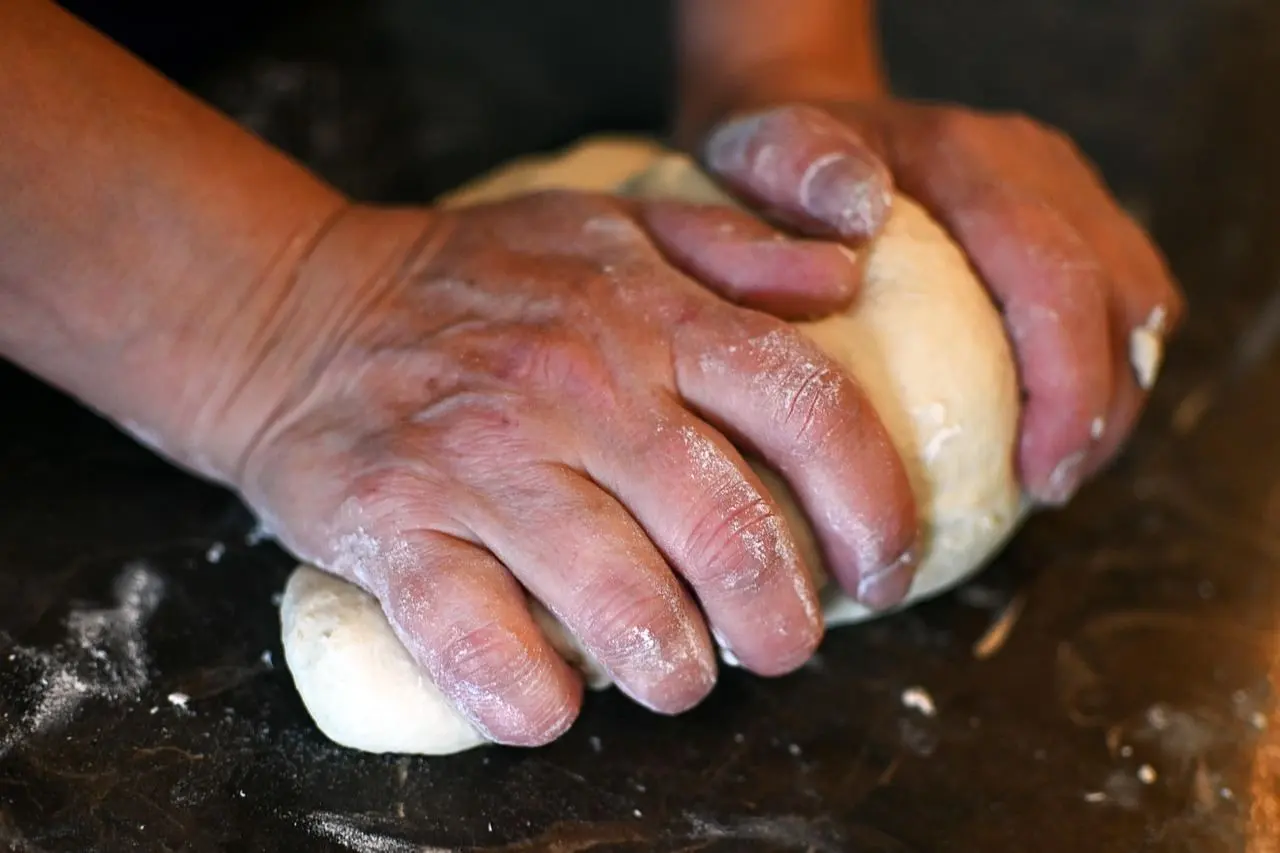
Wondering how to knead bread dough without wrecking it? Fold, push and turn the dough until it turns smooth and springy, then check it with the windowpane test, which shows light through a thin stretch.
This page is one part of the baking for beginners series on core home-baking skills.
| Item | Value |
|---|---|
| Basic fold and turn by hand | 10-15 minutes |
| Stand mixer with a dough hook | 8-10 minutes |
| French Fold for wet dough | 15-30 minutes |
| Rest when the dough turns tough | 3-5 minutes |
| Maximum water temperature | 100°F |
| Hydration where the French Fold suits | Over 65% hydration |
These figures come from Foodal and Nielsen-Massey, and they can change from one recipe or source to the next: check the source before you rely on them.
What kneading does to bread dough
Kneading builds gluten. When flour is hydrated, small dormant protein strands become activated and interlock into a web that lets bread stretch and hold its shape, as Foodal explains.
Gluten can also develop without much handling. The same Foodal guide says a long fermentation of 12-18 hours does that job, while kneading speeds things up for breads made in a shorter time.
Kneading also brings in air. According to Food Republic, air is first incorporated into the dough through kneading, and the gluten structure then holds the bubbles that form as the dough rises.
Kneading is a bread skill, so if you are heading toward pastry instead, how to make shortcrust pastry covers a different kind of dough.
Prepare the dough before you knead
A good knead starts with the mix. Foodal suggests putting the dry ingredients in the bottom of the bowl, forming a well, and pouring in the liquid, with water temperature no hotter than 100°F, because water that is too hot makes the dough very sticky and difficult to work with.
Once you have a shaggy dough, these habits help it come together:
- Draw flour from the edges of the bowl into the centre well with a bowl scraper so the mixture does not clump on your hands.
- Press with the heel of your hand rather than your fingertips, which avoids breaking the outer skin.
- Aim for a texture that is tacky but not sticky: it clings to your hand but releases without clumping.
- Add extra flour only a handful at a time, and only if the dough stays too sticky to work.
It is tempting to keep adding flour to a tacky dough, but Foodal notes that working air into the mixture reduces stickiness, while too much flour leaves a tough, dense block that is likely to tear.
The sources differ on the counter. Foodal begins with a light dusting of flour if the dough feels quite sticky, whereas Nielsen-Massey says not to flour the countertop first for its two wet-dough and sturdy-dough methods.
How to knead bread dough by hand
Three hand methods cover most doughs: a basic fold and turn, the French Fold and the Stretch and Fold. Nielsen-Massey adds that kneading by hand makes it virtually impossible to over-knead, which helps keep bread from turning dense.
Basic fold and turn
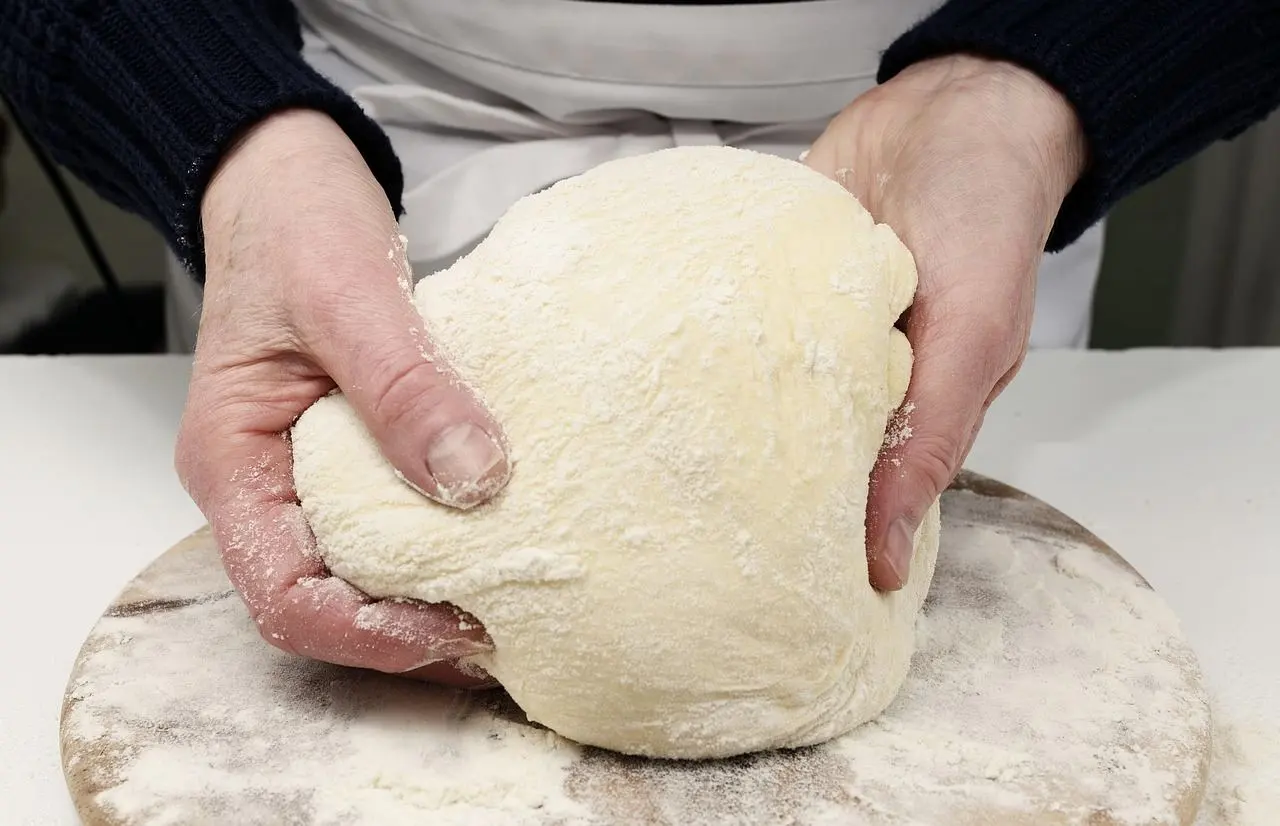
Work the dough for 10-15 minutes until it comes together into a smooth ball, according to Foodal. The basic motion is:
- Fold the dough in half towards yourself.
- Push it forward using the heel of your hand.
- Rotate the dough 90° and repeat, as in the Nielsen-Massey methods.
French Fold for wet dough
The French Fold uses the stickiness of wet doughs, which Nielsen-Massey says usually have a hydration of over 65%. Plan on 15-30 minutes of repeating these steps on a clean, dry counter:
- Lift the dough out of the bowl with a bench scraper and set it on the counter.
- Grab one side with both hands, fingers under the dough and thumbs on top.
- In one motion, pick the dough up, rotate it 90°, flip it towards you and gently slap it down so one half sticks to the counter.
- Stretch the half you are holding upwards and fold it away from you over the half stuck down.
- Keep rotating in the same direction each time until the dough is smooth.
Stretch and Fold for sturdier dough
This method suits doughs with less than 65% hydration, and Nielsen-Massey gives a range of 10-30 minutes. Again, start on a clean, dry counter:
- Hold down the side of the dough closest to you with one hand.
- Grab the far half with the other hand and stretch it away from you.
- Fold it back towards you on top of itself, then rotate the dough 90° and repeat.
Kneading in a stand mixer
A mixer fitted with a hook can do the work. Foodal advises liquid ingredients in the base of the bowl with the dry on top, a medium to medium-low speed, and a finish in about 8-10 minutes.
Speed has a catch. Food Republic says a mixer tends to be more efficient and consistent than hands for yeasted doughs, but you can miss the signs that the dough should rest, so check its elasticity every couple of minutes.
Over-kneading in a machine can stop the bread rising properly and give a dense loaf. The dough is done when it clings to the hook as a smooth ball and no longer sticks to the walls of the bowl.
How do you know when dough is kneaded enough?
Foodal describes three ways to check gluten formation, moving from the quickest to the most thorough:
- Sight: the dough forms a completely smooth ball.
- Touch: press a fingertip into the skin and the dent should slowly spring back.
- Windowpane: stretch a small piece until it is thin enough for light to pass through it like a window without tearing.
If the dent does not spring back, Foodal says to give the dough 5-10 more folds and turns. The windowpane description comes from Food Republic, which says a dough that stretches without tearing is ready.
Descriptions of the poke test vary. Nielsen-Massey says a dent that fills in quickly means the dough is properly kneaded, while a dent that stays for a long time means you should keep kneading to develop the gluten.
Fixing common kneading problems
- Tough and resistant: the gluten is tired, so step away for 3-5 minutes, per Foodal, or five minutes per Nielsen-Massey.
- Tearing as you fold: the gluten strands are breaking rather than stretching, so work more gently and rest the dough if the tearing continues.
- Breaks when stretched thin: under-kneaded dough has underdeveloped gluten, so keep kneading.
- Feels tight and then breaks: over-kneaded dough may improve if you let it rest longer before shaping.
When the dough has risen and is ready to bake, an oven temperature conversion guide helps if your recipe uses a different scale from your oven dial.
Frequently asked questions
Can you over-knead dough by hand?
Show answer
It is very unlikely. Nielsen-Massey describes hand kneading as making over-kneading virtually impossible, though dough that turns tight and snaps when stretched is a sign to pause.
How long should I knead bread dough?
Show answer
Use the clock only as a rough guide. A plain push-and-fold by hand often runs 10-15 minutes according to Foodal, a mixer hook about 8-10 minutes, and the French Fold 15-30 minutes per Nielsen-Massey. The smoothness, touch and windowpane checks matter more than minutes.
Should I flour the counter when kneading?
Show answer
Try to resist it. Extra flour can leave the loaf heavy, and the stickiness usually eases as you work. If the dough is truly unmanageable, add a little at a time.
Do I still need the windowpane test with a stand mixer?
Show answer
Food Republic admits the test can be fiddlier with machine-kneaded dough, yet calls it one of the best indications of dough that has been kneaded just right, so it still earns its place.