
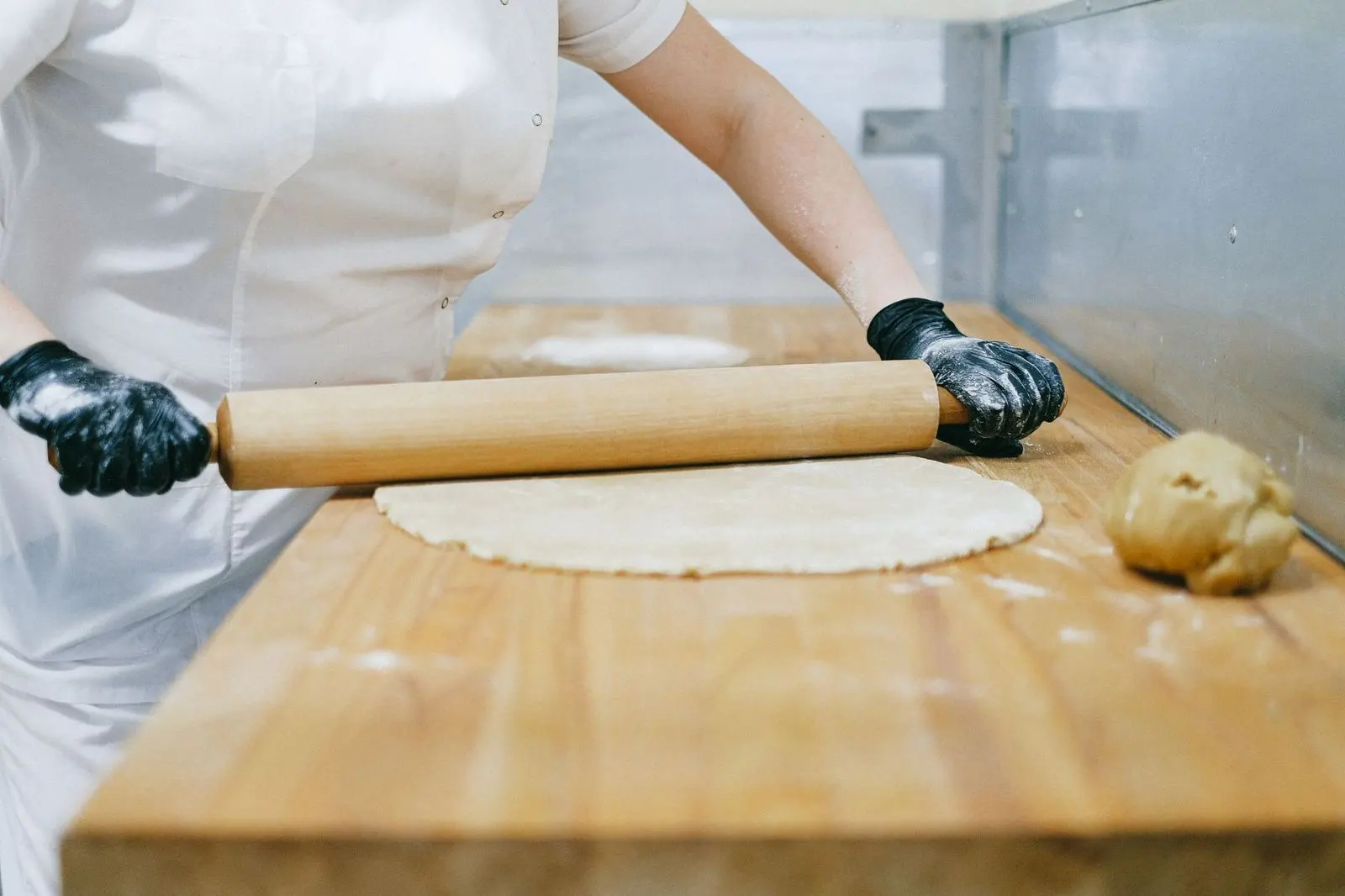
Wondering how to make shortcrust pastry without it turning tough or shrinking? Rub cold butter into plain flour until it looks like fine breadcrumbs, bind with a little cold water, then chill before rolling.
This guide is part of our baking for beginners series, so it covers the core method and the usual fixes.
| Item | Value |
|---|---|
| Flour and butter in one basic recipe | 225g plain flour and 100g butter |
| Fat to flour proportion | Half fat to flour |
| Water for that recipe | 2-3 tbsp |
| Chilling before rolling | 20 minutes |
| Blind baking with foil and beans | 15-20 minutes |
The figures come from BBC Good Food and RNZ. Recipes differ and published figures can change, so check the source before you rely on them.
What goes into shortcrust pastry
Shortcrust pastry is a simple dough of flour, cold fat, a pinch of salt and a little cold water. The basic recipe from BBC Good Food uses 225g plain flour, 100g butter and a pinch of salt, and its tip for scaling up or down is to keep the proportions at half fat to flour.
Other recipes shift the balance. Wessex Mill lists 200g flour and 100g butter with 5-7 tbsp cold water, while RNZ gives a richer version with 225g flour, 170g butter and an egg yolk mixed with 4 Tbsp chilled water.
The choice of fat is a matter of taste and texture. Nigella.com notes that butter contains more water than lard or vegetable shortening and suggests half butter and half shortening for a flakier result, whereas RecipeTin Eats argues that an all-butter crust is flaky enough and tastes better.
Whatever the ratio, the aim is the same, as RecipeTin Eats explains:
- Cold butter should end up as tiny pieces in the dough, not melted or creamed through it.
- Those pieces melt in the oven and leave air pockets, which is what makes the pastry flaky.
- Cold water matters for the same reason, and BBC Good Food warns that too much of it makes the pastry hard.
For a sweet crust, RNZ suggests adding 1 Tbsp caster sugar to the flour. None of the recipes quoted here uses a raising agent, so our guide to baking powder vs baking soda is relevant to cakes and cookies rather than to this dough.
How to make shortcrust pastry by hand
The hand method is the same in most recipes: rub in, bind, then rest. Keep everything cold and handle the dough as little as you can.
- Sift the flour into a large bowl, add the diced cold butter and rub it in with your fingertips until the mixture resembles fine breadcrumbs, as BBC Good Food describes.
- Stir in the salt, then add the water. The same BBC Good Food recipe calls for 2-3 tbsp water mixed to a firm dough.
- Add the liquid in stages. Nigella.com advises adding half to three-quarters first, checking whether the dough binds, and adding the rest a little at a time.
- Press a few clumps together between your fingers. If they hold, you have added enough liquid, and if dry patches remain you can add a little more.
- Bring the dough together into a smooth ball. BBC Good Food says to knead briefly and gently on a floured surface, while Nigella.com suggests avoiding kneading altogether.
- Wrap the dough in cling film and chill it.
Wessex Mill says the key to light pastry is proper butter, mixed quickly with the flour using a fork or pastry blender rather than your fingers. Warm hands are the reason: they soften the butter you are trying to keep in small pieces.
Making the dough in a food processor
A food processor is faster, and the main risk is overworking the dough. RecipeTin Eats pulses the flour and salt briefly, scatters the butter over and pulses until the largest butter pieces are the size of a chickpea.
With the motor running on low, that recipe drizzles in 2.5 tbsp of ice cold water. The dough should look crumbly but stick together when pinched, and if it stays sandy the recipe adds another 1/2 tbsp of cold water and blitzes again.
RNZ likewise says to mix only until the mixture forms large clumps, then tip it onto a clean bench and knead it together. Nigella.com adds that you should try not to process the dough into a ball, because that tends to toughen the gluten.
Tip the crumbly dough out and bring it together with your hands. Pat it into a disc, wrap it and refrigerate.
Chilling, rolling and lining the tin
RNZ says to chill the finished dough for 20 minutes before rolling it out and lining a flan dish or tartlet tins, then to chill again until firm. Nigella.com adds that resting after rolling matters even more, because rolling toughens the gluten again and a rest lets it relax slightly.
Roll on a floured surface. Wessex Mill rolls its pastry to 3mm thick, and RNZ gives the dough a quarter-turn after each roll to keep it round.
For a pie dish, RecipeTin Eats rolls a circle 10cm / 4″ larger than the dish so there is at least 1.25cm / 1/2″ of excess around the rim. It then rolls the pastry onto the pin and unrolls it over the tin, draping it in rather than stretching and pulling, since stretching causes shrinkage.
Baking blind and setting the oven
Baking blind means partly baking the empty case so it does not go soggy under a wet filling. RNZ lines the pastry with foil, fills it with baking beans and bakes for 15-20 minutes before removing the foil and beans and carrying on with the recipe.
Nigella.com allows greaseproof or parchment paper with beans, pie weights or rice to support the edges and reduce shrinking. It removes the weights and paper for the last few minutes so the base can dry out, and it leaves a small overhang to trim after baking.
Wessex Mill gives 180°C, Fan 160°C, 350°F, Gas 4, or as per your own recipe. If your oven dial uses a different scale, our page on oven temperature conversion can help you translate it.
You may not always need this step. RecipeTin Eats says its crust will not go soggy without blind baking as long as the total bake time is 40 minutes or more.
Troubleshooting common problems
- Shrinking: Nigella.com says the gluten in the flour contracts in the oven heat. Add liquid gradually, avoid kneading, chill after rolling and use weights when baking blind.
- Hard pastry: too much water is the usual cause, according to BBC Good Food. Start with less and add more only if the dough will not bind.
- Sandy, crumbly dough: if it will not hold when pinched, add a small splash of cold water and mix again, as the food processor method above shows.
- Dough that is suddenly too wet: Wessex Mill says to cover it and leave it to stand for 10 minutes.
- Soggy base: bake blind first, or make sure the filling bakes long enough, as described in the previous section.
- Sagging crimps: RecipeTin Eats recommends a thicker rim so crimps hold their shape, and a chill after decorating because the butter softens while you work.
Frequently asked questions
What is the ratio for shortcrust pastry?
Show answer
A common rule is one part fat to two parts flour, which BBC Good Food words as half fat to flour. Richer doughs with more butter are crumblier and harder to handle, a trade-off RecipeTin Eats describes as one best left to professionals.
Do I have to chill the dough?
Show answer
Chilling re-firms the butter. RecipeTin Eats says refrigerating makes the tiny butter bits cold again, which supports a flaky texture, while resting also relaxes the gluten.
Can I make shortcrust pastry without a food processor?
Show answer
Yes. Besides rubbing in with your fingertips, you can cut the butter into the flour with two knives or a pastry cutter until it looks like coarse breadcrumbs, as RNZ describes.
Do I always need to blind bake?
Show answer
No. RecipeTin Eats calls the step optional, and says a crust should be baked fully when the filling needs no baking, such as a cream pie.