
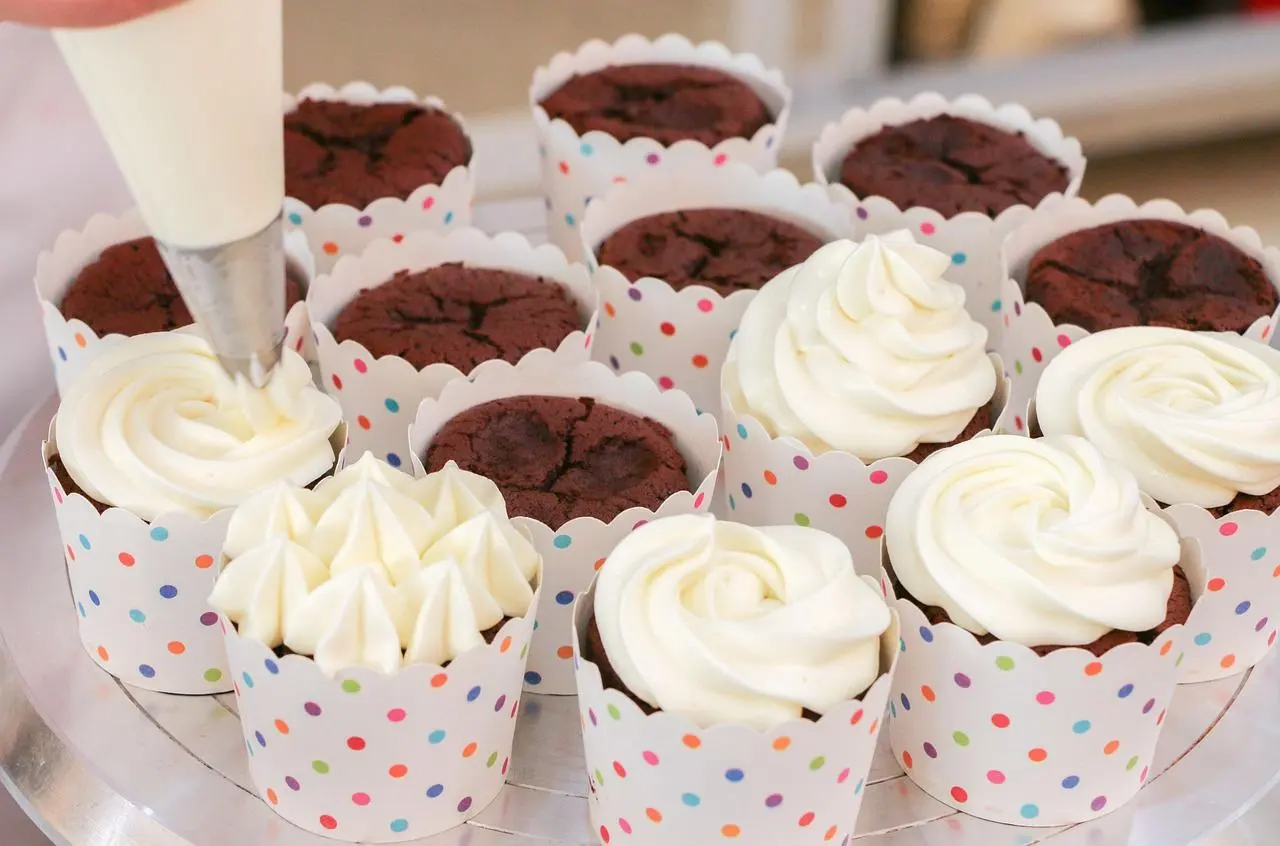
Wondering how to make buttercream that is smooth, not grainy or greasy? Beat butter with icing sugar for a quick American style, or whisk egg whites and sugar first for a silkier meringue version.
This guide is part of the easy dessert recipes collection for home bakers.
| Item | Value |
|---|---|
| American buttercream ratio | 1 part butter to 2 parts icing sugar by weight (1:2) |
| Swiss meringue buttercream ratio | 1:2:3 egg white: sugar: butter by weight |
| Swiss meringue heating temperature | 71°C |
| Italian meringue sugar syrup temperature | 118°C |
| Buttercream for an 8in (20cm) two-layer cake | roughly 650g |
| Freezer storage | up to 3 months |
These figures come from the BakeCalcs buttercream variants calculator and can change, so check the source before you rely on them.
The main types of buttercream
Buttercream is a family of frostings rather than a single recipe. Most share butter, sugar and often eggs, but each type is prepared differently, which changes its texture, taste and consistency, as Wilton explains.
- American: butter and powdered sugar beaten until light and fluffy, the quickest and easiest option.
- Swiss meringue: egg whites and sugar warmed together, whipped, then beaten with butter.
- Italian meringue: hot sugar syrup streamed into whipping egg whites before the butter goes in.
- French: egg yolks and sugar syrup whipped, then beaten with butter.
- German: butter beaten into cooled pastry cream, also called crème mousseline.
- Ermine: sugar and flour cooked together before the butter is beaten in, also called flour buttercream.
The descriptions above follow the Wikibooks buttercream page. It also lists a decorator’s version, where a large proportion of the butter is replaced with vegetable shortening to increase stability, at the cost of some flavour.
How to make American buttercream
American buttercream is made by beating together butter and powdered sugar until light and fluffy, according to Wikibooks. It is very easy to make, but it is not particularly stable and can form a thin crust when exposed to air for long periods.
A standard starting point is 1 part butter to 2 parts icing sugar by weight (1:2), with a splash of milk, per the BakeCalcs calculator. Using less sugar gives a less sweet, softer frosting.
- Let the butter soften to room temperature so it beats smoothly.
- Weigh the icing sugar at twice the weight of the butter.
- Beat the butter and sugar together with a splash of milk and a little vanilla until smooth.
- Add more sugar to stiffen the mixture for piping, or a little more milk to loosen it for spreading.
Wilton describes this style as softer and more spreadable than most frostings, yet it can be stiffened to pipe flowers and roses. It also holds colour very well, especially blacks and reds, which makes it a practical choice if you plan to tint it (Wilton).
How to make Swiss and Italian meringue buttercream
Meringue buttercreams start with egg whites and sugar. For Swiss, the ratio is 1:2:3 egg white: sugar: butter by weight, with the whites and sugar heated over a bain-marie to 71°C and then whipped with the butter, as listed by BakeCalcs.
- Combine the egg whites and sugar in a large heatproof bowl and set it over a pot of simmering water.
- Stir continuously with a whisk until the sugar has dissolved.
- Take the bowl off the heat and beat the whites with an electric mixer until stiff.
- Let the meringue cool fully, because warm meringue will melt the butter.
- Mix in the butter a tablespoon at a time, beating well after each addition.
- If the mixture looks curdled, keep beating until it comes back together.
The method above follows a Sew Historically recipe, and the cooling tip matches Wilton’s advice. Wilton adds that Swiss buttercream is so soft that it suits frosting cakes better than piping or decorating.
Italian meringue buttercream uses the same ratio, but the sugar is boiled to a 118°C syrup and streamed into the whipping whites (BakeCalcs). The Vanilla Valley calls it the most difficult to make and the most stable of all buttercreams, and warns that hot syrup could splash you or be flicked by the whisk.

Wilton notes that Italian buttercream is best the day it is made. Pasteurized eggs may be used, but they do not whip up as well as regular eggs and yield less frosting (Wilton).
Which buttercream should you choose?
The right type depends on what the frosting has to do. These pointers draw on the sources linked in each line.
- Tinting and piping: American is a strong choice because it holds colour well and can be stiffened (Wilton).
- Warm rooms and detailed work: Italian meringue is described as more stable and suited to intricate designs and warmer climates (The Vanilla Valley).
- Less sugary frosting: German is the least sweet, followed by Swiss and Italian meringue, while American is the sweetest (BakeCalcs).
- Rich and yellow-tinted: French is less sweet than American, and the yolks give it a yellow tint (Wikibooks).
If you want something to frost, the fudgy brownies recipe is one bake to pair with a batch. For a different kind of sweet treat, see the millionaire’s shortbread recipe.
Quantities and storage
As a rough guide, an 8in (20cm) two-layer cake needs roughly 650g of buttercream for a fill plus a medium coat, and the amount scales with the square of the diameter. For very thick or heavily piped finishes, add 15-20% (BakeCalcs).
The Vanilla Valley says buttercream can be refrigerated for up to a week in an airtight container, then left to come to room temperature and re-whipped to bring back its fluffy texture. It can also be frozen for up to 3 months, moved to the fridge for 24 hours to thaw, and whipped again (The Vanilla Valley).
Frequently asked questions
Why does my meringue buttercream look split?
Show answer
A broken look partway through is a normal stage with Swiss meringue buttercream, per the Sew Historically recipe. Keep whisking and the butter should blend in; a soupy result usually points to meringue that was still warm.
Can I make buttercream without eggs?
Show answer
Yes. American and flour (ermine) buttercream are both described as egg-free by Sew Historically, and American is the simplest of the two.
What is ermine buttercream?
Show answer
It is also known as boiled frosting or flour buttercream, and Wilton says it tastes similar to cream cheese frosting even though it contains none. Cool the cooked mixture completely before adding butter, and seal it while it cools so no skin forms.
Can I make buttercream ahead of time?
Show answer
Yes. Store it airtight in the fridge, let it soften at room temperature, then re-whip it before use, as The Vanilla Valley advises.